

Education

Hyper-specialists vs renaissance engineers: How China and India are reimagining human capital for AI Age

China is betting on Technocratic Resilience. By flooding the market with deep specialists in AI and big data, China aims to dominate the production of new technologies. India is betting on Holistic Resilience. The premise is that AI will eventually commoditise coding and routine technical tasks. Therefore, the premium will shift to human skills. The early twenty-first century has witnessed a bifurcation in the educational strategies of Asia’s two demographic superpowers. As the global economy transitions into the Fourth Industrial Revolution – characterised by the fusion of physical, digital, and biological spheres – the People’s Republic of China and the Republic of India are adopting diametrically opposite approaches to human capital formation. This is not merely a matter of pedagogical preference – it represents a fundamental disagreement on the nature of the modern citizen and the specific type of intellectual resilience required to navigate an age dominated by Artificial Intelligence (AI). In China, the educational zeitgeist is defined by the “New Engineering” (Xin Gongke) initiative. This state-directed strategy seeks to dissolve traditional disciplinary boundaries, not to broaden the humanist horizon, but to hyper-specialise the workforce in emerging strategic industries. Conversely, India, through its National Education Policy (NEP) 2020, is attempting a “holistic turn,” betting on the “Renaissance Engineer” – a professional capable of critical thinking and social awareness – as the key to moving India’s economy up the global value chain.
Hyper-specialists vs renaissance engineers: How China and India are reimagining human capital for AI Age Read More »

NTA Issues Advisory for JEE Main 2026 Candidates in Nanded Amid “Hind Di Chadar” Samagam

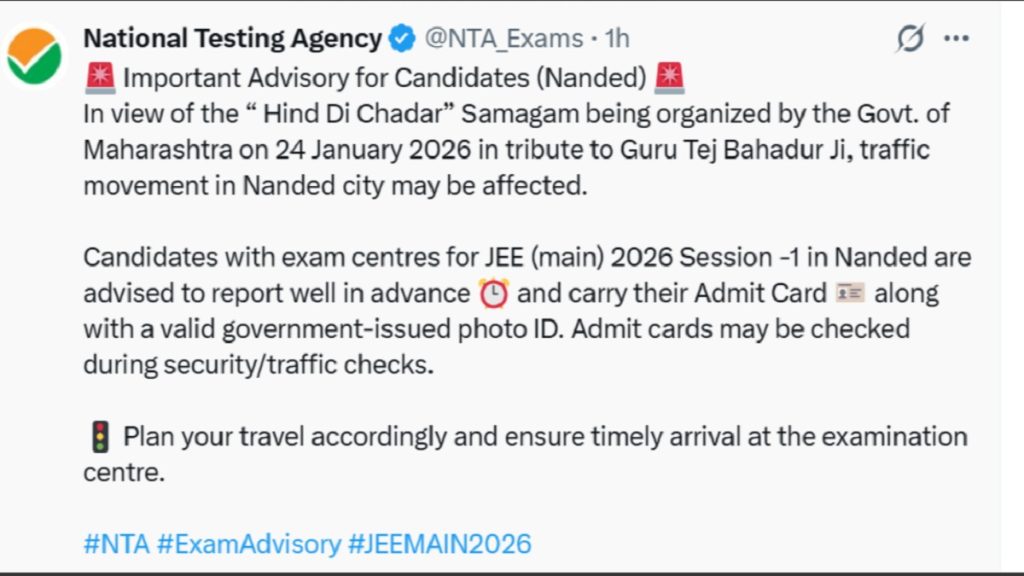
JEE Main 2026 Session 1: National Testing Agency has issued an important advisory for candidates appearing for JEE Main 2026 session I in Nanded. The advisory comes in view of “Hind Di Chadar” Samagam, being organised by Government of Maharashtra on January 24, 2026 to pay tribute to Guru Tej Bahadur Ji, a revered spiritual leader. The event is expected to draw large crowds, which may affect traffic movement across Nanded city on day 4 of JEE Main 2026 exam. To ensure smooth experience for candidates, NTA has urged all candidates to plan their travel in advance and reach JEE Main 2026 exam centres early. Advisory for JEE Main 2026 Candidates in Nanded Candidates must go through these JEE Main session 1 advisory Report in Advance: Candidates should leave home early and anticipate possible traffic delays due to Samagam.Carry Admit Card and ID: Candidates must bring their JEE Main admit card along with a valid government-issued photo ID like Aadhaar card, PAN card, passport, or driving license. These may be checked during security or traffic inspections.Follow Instructions at Exam Centre: They are advised to follow all instructions provided by NTA officials at exam centres for safety and smooth conduct of exam.NTA has emphasised that late arrival may lead to disqualification from exam, so careful planning is important. Candidates must check location of their exam centres beforehand and plan their route accordingly.

NTA Issues Advisory for JEE Main 2026 Candidates in Nanded Amid “Hind Di Chadar” Samagam Read More »

Listings
News
Home
Jobs
Contact